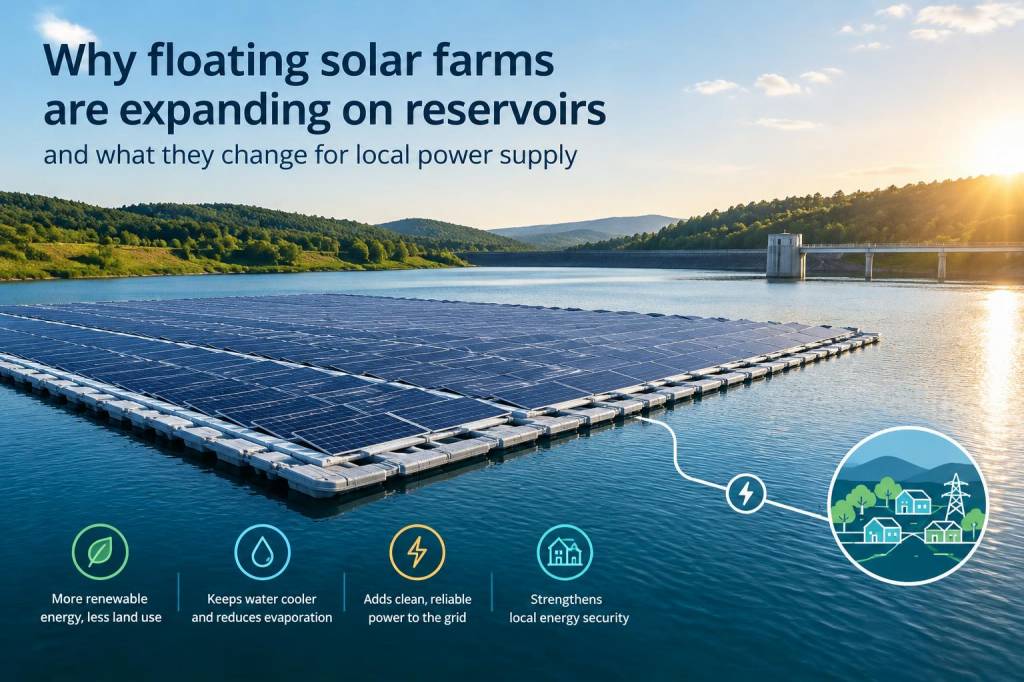
Floating solar farms are moving from a niche idea into a practical energy strategy, and I have watched that shift with growing interest. What once felt experimental now makes sense to utilities, water managers, and local communities that want more clean electricity without competing for scarce land. When I look at reservoirs, I see more than stored water. I see a surface that can generate power, reduce evaporation, and support a more flexible local grid.
That is why reservoir-based floating solar is expanding so quickly. It solves several problems at once. It places panels close to existing substations and water infrastructure, it avoids many land-use conflicts, and it can perform well because water naturally cools the panels. From my perspective, that combination is hard to ignore, especially in regions where land is expensive, farming areas are protected, or urban demand is rising faster than available space.
Why reservoirs have become a natural home for floating solar
When I examine site selection for new solar projects, reservoirs stand out for a simple reason: they are already engineered spaces. They usually have access roads, grid connections, security perimeters, and water management teams. That lowers friction compared with building on undeveloped land. A reservoir also tends to sit near population centers or industrial zones, which makes power delivery more efficient.
There is another reason I find important. Reservoirs are not competing with housing, crops, or forests. In many places, that matters as much as the technology itself. Utility-scale solar can face delays when communities worry about land conversion, visual impact, or habitat loss. Floating systems reduce some of those pressures because they use water surfaces that are already altered by human activity.
I also think climate stress is accelerating adoption. As droughts become more frequent in some regions, water utilities want ways to protect stored water from evaporation. Solar arrays on the surface can shade part of the reservoir and reduce direct sunlight exposure. That does not solve every water-loss issue, but it can help, especially where every saved cubic meter matters.
What changes once panels sit on water
The first change is technical. Floating systems often run slightly cooler than comparable ground-mounted arrays because surrounding water helps dissipate heat. In practical terms, cooler panels can convert sunlight into electricity more efficiently, particularly during hot afternoons when demand can be high. I would not overstate the gain, but even a modest efficiency improvement can matter at scale.
The second change is operational. Reservoir projects can be designed to match local demand patterns more closely than large remote solar farms. If a city or industrial zone needs daytime power, a nearby floating array can feed electricity into the local network with lower transmission loss than a plant located far away. That is especially useful where local grid capacity is limited.
The third change is environmental management. I often hear concerns about whether covering water surfaces will harm ecosystems. That is a fair question. Any project that changes light, temperature, or wind exposure can affect aquatic life. Still, not every reservoir functions like a natural lake. Some are already used for drinking water, irrigation, hydroelectric storage, or flood control. In those settings, careful design can balance energy production with water quality and habitat protection.
What local power supply gains from floating solar
From a local supply perspective, floating solar farms do something valuable: they add generation without requiring a new land parcel outside the existing system. That can strengthen resilience in areas where demand is rising faster than infrastructure upgrades. I see three major benefits.
- More local generation: Electricity can be produced closer to the point of use, which helps reduce congestion on the grid.
- Better daytime supply: Output often matches peak daylight demand for cooling, commercial activity, and public services.
- Complementary infrastructure use: Existing reservoir sites can support energy production without large new land take.
In communities that already depend on reservoir infrastructure, floating solar can also create a more integrated energy-water system. I find that especially promising when combined with pumping stations, water treatment facilities, or nearby battery storage. In such cases, the reservoir site becomes part of a broader local energy hub rather than a single-purpose asset.
Battery storage deserves special mention. Solar output is naturally variable, and local supply needs can change by hour. When floating solar is paired with storage, operators can shift daytime generation into evening peaks or emergency reserve periods. That makes the reservoir site more useful for grid balancing and can reduce reliance on fossil-fuel backup plants.
The practical concerns I pay attention to
I never treat floating solar as a universal answer. It works well in many places, but it also brings constraints. Mooring systems must be engineered for wind, waves, and changing water levels. Reservoir operations can create fluctuating conditions that are not gentle on equipment. Ice, storms, sediment, and extreme temperature swings can all affect durability.
Maintenance also matters. A floating array is accessible, but it is not identical to a rooftop or ground array. Crews need safe access pontoons, inspection procedures, and plans for cleaning panels without harming water quality. If the reservoir serves drinking water functions, that adds another layer of oversight.
Then there is the question of ecological impact. I think honest projects should study how much surface coverage is appropriate. Too much shading can alter oxygen levels, water temperature, and plant growth. In some reservoirs, a partial coverage strategy may be better than a full buildout. The goal should be to match design to local conditions, not to cover water simply because it is available.
| Project Factor | Potential Benefit | Point of Attention |
|---|---|---|
| Reservoir location | Near existing grid and water infrastructure | Access rights and operational coordination |
| Water cooling | Possible efficiency improvement | Need to monitor long-term performance data |
| Surface coverage | Reduced evaporation and land use pressure | Possible effects on aquatic ecosystems |
| Local grid connection | Lower transmission losses | Capacity limits and interconnection costs |
| Battery pairing | More flexible supply profile | Higher upfront investment |
Why utilities and municipalities are paying closer attention
When I speak about floating solar with energy planners, I notice that the conversation is no longer about novelty. It is about portfolio planning. Utilities want a mix of generation assets that can withstand weather stress, land constraints, and demand growth. Municipalities want stable bills, reliable supply, and visible progress on climate targets. Floating solar fits into that conversation because it is practical, scalable, and easy to explain to residents.
It also helps that the economics are becoming more attractive. Panel prices, engineering expertise, and project experience have all improved. As more installations are completed, lenders and developers gain confidence in the technology. That matters because energy infrastructure is often slowed not by science, but by uncertainty. Once a project type proves repeatable, capital starts to flow more easily.
In some cases, reservoirs already host hydroelectric assets, which opens an especially interesting path. Solar production during the day and hydro generation later can complement each other. I find this pairing compelling because water can act as a kind of energy buffer. If solar output is strong, hydro resources can be conserved for later use. If clouds reduce solar output, hydro can help fill the gap. That kind of coordination can make local supply more stable.
What residents often want to know
People usually ask me whether floating solar will change the look of a reservoir. Yes, it will, but the visual impact can vary a lot. Some projects cover only a small percentage of the water surface, and many are designed with neat geometry that looks orderly rather than intrusive. In my experience, public acceptance improves when project leaders explain why a site was chosen and how much of the reservoir will remain open.
Another common question is whether floating panels affect drinking water. That depends on the reservoir and the design. Materials must meet safety standards, and operators must monitor water quality carefully. The technology itself is not a shortcut around regulation. In fact, successful projects usually rely on stricter oversight because the water surface serves more than one purpose.
People also ask whether the power really helps local communities or simply flows elsewhere. That depends on ownership, grid structure, and contract design. I think the most meaningful projects are those that connect directly to local needs, whether that means supplying a town, stabilizing a regional utility, or supporting industrial users that need cleaner electricity.
Where I think floating solar is heading next
I expect reservoir projects to keep expanding in places where land is tight, sunlight is strong, and water infrastructure is already in place. I also expect designs to become more customized. Some reservoirs will support large arrays, while others will use smaller systems focused on self-consumption or grid support. As better monitoring tools arrive, operators will be able to track evaporation savings, performance gains, and ecological effects with greater precision.
What excites me most is not just the panels themselves, but the systems thinking behind them. Floating solar encourages a smarter use of shared infrastructure. It turns water surfaces into energy assets while reminding us that clean power is not only about generating electrons. It is also about planning land, water, and grid resources in a more connected way.
In places where local power supply feels stretched, that kind of thinking can be transformative. Reservoir-based solar will not solve every energy challenge, but it can make supply cleaner, more flexible, and more local. That is a meaningful shift, and I think we are only beginning to see how far it can go.