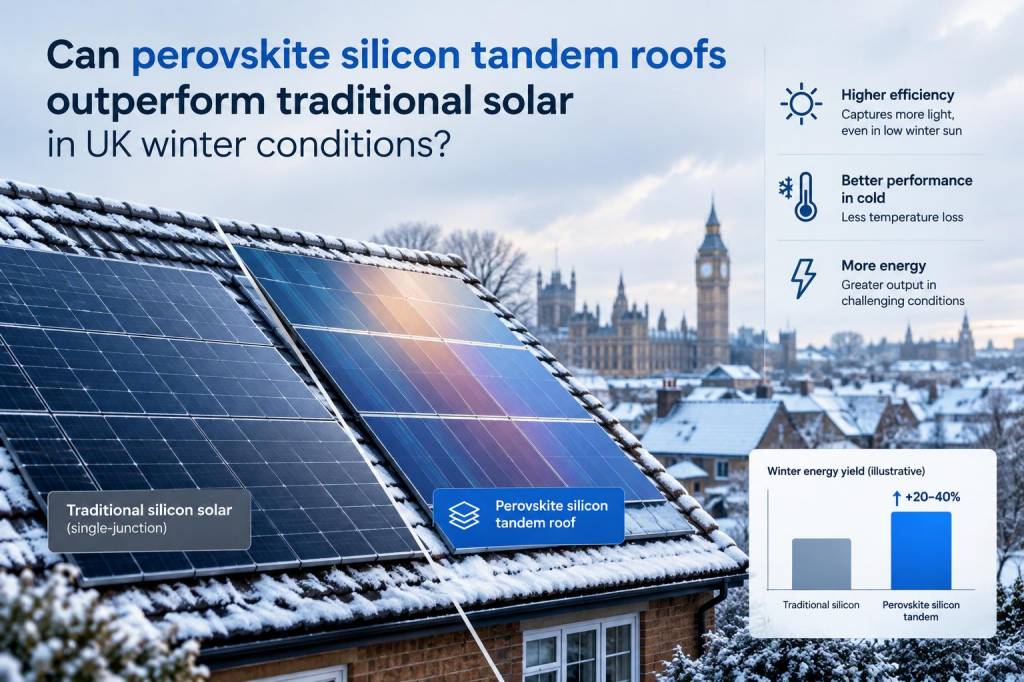
When I first started looking into perovskite-silicon tandem solar for UK roofs, I was sceptical. The headlines promise dramatic efficiency gains, but the UK winter is unforgiving: low sun angles, long periods of cloud cover, and frequent rain or even sleet. After digging into the science, talking to researchers and installers, and comparing real-world performance data where available, I’ve come away convinced that perovskite-silicon tandems could offer meaningful benefits over traditional silicon panels in winter—but there are important caveats.
Why tandems might be better in winter
Traditional silicon panels convert the visible part of the solar spectrum well, but they leave a lot of the infrared and ultraviolet energy underutilised. Perovskite-silicon tandems stack a perovskite cell (which absorbs higher-energy photons efficiently) on top of a silicon cell (which captures lower-energy photons). In practical terms, that means:
Put simply: when the sun is weak or the light is scattered through cloud, extracting more usable photons from the available spectrum matters. Tandems are designed to do that.
What winter conditions mean for rooftop PV
The UK winter typically brings:
Any rooftop technology that can squeeze more energy from low and diffuse light has a clear advantage. However, rooftop installations also contend with practicalities—roof inclination, orientation, shading from chimneys or trees, and the need for robust weatherproof encapsulation.
Real-world performance vs laboratory claims
Lab efficiencies are impressive for tandems, but rooftop reality is messier. Here are the practical gaps I found:
Practical comparison: tandem vs conventional silicon in UK winter
| Typical winter output (relative) | Key advantages | Key risks | |
|---|---|---|---|
| Conventional silicon (monocrystalline) | Baseline (1.0) | Proven durability, established supply chains, strong warranties | Lower spectral efficiency under diffuse light |
| Perovskite-silicon tandem | ~1.2–1.4 (site dependent) | Higher spectral response, better low-light yields, potential for more kWh/m2 | Emerging durability profile, potential early-life degradation, higher upfront costs initially |
Note: the relative figures above are illustrative; actual performance will depend on module quality, tilt/orientation, shading, and local weather.
Installation and integration considerations
As someone who evaluates both technology and market readiness, I pay close attention to how easily a new product fits into existing installation workflows. For perovskite-silicon tandems that means:
Cost, payback and the business case
Costs are falling fast for tandems but they’re not yet as inexpensive as commodity silicon panels. That said, because tandems can produce more energy per square metre, the economic question for UK roofs often becomes one of area-constrained systems: if you have limited roof space, a higher-efficiency module can give you better returns.
Factors I weigh when modelling payback:
What I recommend to homeowners and businesses considering tandems now
I believe perovskite-silicon tandems represent a compelling technological step for the UK market—especially for rooftops with limited space or for commercial installations where winter energy yield is critical. But they’re not yet a universal, drop-in replacement for conventional silicon; the choice should be guided by roof constraints, appetite for early-adopter risk, and careful scrutiny of warranties and field performance.
At Energy News I’ll keep tracking deployments and publishing updates as more long-term UK field data becomes available. If you’re weighing options for a winter-focused rooftop project, I’m happy to review product datasheets and help you interpret the likely real-world impact on your energy yields and payback assumptions.