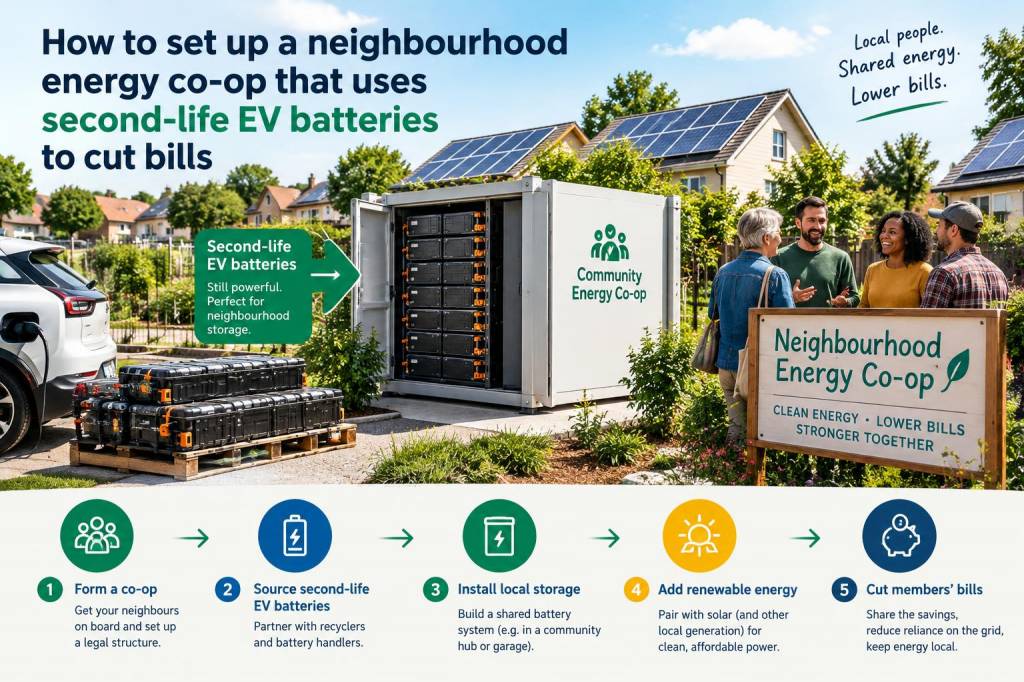
I’ve been fascinated by the idea that communities can take control of their energy future — and one practical, increasingly viable route is a neighbourhood energy co-op built around second‑life electric vehicle (EV) batteries. These batteries, once deemed unsuitable for driving ranges, often retain 70–80% of their capacity and can perform excellently in stationary storage roles. In this article I’ll walk you through the why and how, share practical tips, and flag common pitfalls from people who’ve tried — and succeeded.
Why a neighbourhood co-op with second‑life EV batteries?
There are several compelling reasons to pursue this model. First, cost savings: by using stored energy during peak-price periods and exporting when prices are higher, a co-op can reduce household bills across the board. Second, resilience: shared storage smooths out local outages and helps integrate rooftop solar effectively. Third, sustainability: repurposing EV batteries extends their useful life and avoids premature recycling. Finally, community empowerment: co-ops keep control local, build skills, and can redirect financial benefits into neighbourhood projects.
What you’ll need to start
Setting up a co-op is both a community project and a technical one. You’ll need to cover governance, finance, site selection, hardware, and regulatory compliance. Here’s a compact checklist to get you moving:
Form the people side first
I always recommend starting with people, not tech. Host an open meeting and present clear benefits: expected bill reductions, potential income from grid services, environmental impact, and how decisions will be shared. You’ll want a steering committee with roles: chair, treasurer, technical lead, member liaison. Transparency is key — publish minutes and simple financial models so members can see where their money goes.
Choose the right legal structure
In the UK, many community energy projects use a Community Benefit Society (BenCom) or a cooperative under the Cooperative and Community Benefit Societies Act. These structures provide democratic governance and make it easier to raise local investment through community shares. Consult a solicitor familiar with community energy projects — it’s worth getting the governance document right at the start.
Technical overview: batteries, inverters, and energy management
Second‑life EV batteries come in various formats — modules salvaged from cars (e.g., Nissan Leaf, Renault Zoe) or purpose-repacked units offered by specialist firms. You’ll need certified testing to assess capacity and safety. The basic hardware stack includes:
Companies like RecycEV, Renault’s second-life program, and specialist integrators such as Moixa and Powervault can offer components or turnkey systems. Evaluate warranties and modularity — you want a system that can grow as membership expands.
Site selection and sizing the system
Common sites are community centres, schools, car parks, or a cluster of garages. Choose a location with secure access, good ventilation, and proximity to a low-voltage grid connection point. To size the system, gather energy usage data from participating homes (smart meter data is ideal) and any local generation (rooftop solar). A simple sizing rule of thumb: if you want to cover evening peaks, add 2–4 kWh per participating household, but modelling peak shaving and export revenue requires simulation.
| Metric | Small (10 homes) | Medium (50 homes) | Large (200 homes) |
|---|---|---|---|
| Battery capacity (kWh) | 30–50 | 100–200 | 500–800 |
| Typical capital cost (second‑life) | £10k–£20k | £30k–£80k | £120k–£300k |
| Expected annual bill savings | £50–£150 per household | £80–£300 per household | £100–£500 per household |
Financing and business models
Funding can come from a mix of community shares, grants (local authorities, National Lottery Community Fund, or energy transition funds), loans, and commercial partners. Popular models include:
Be transparent about payback timelines (often 5–10 years depending on incentives), risk allocation, and exit terms for members who leave.
Regulatory and technical considerations
Grid export rules, metering arrangements, and safety standards matter. In the UK you’ll need to coordinate with your Distribution Network Operator (DNO) for connection capacity and potential constraints. For revenue streams like grid services (frequency response, demand turn-up), explore aggregators such as Younicos, Flexitricity, or Kiwi Power — they can bundle small assets to participate in markets. Ensure your EMS can communicate with aggregators and comply with metering and settlement requirements.
Operations: maintenance, monitoring and lifecycle
Plan for ongoing maintenance: battery health checks, inverter firmware updates, and safety inspections. A maintenance contract with a specialist is generally sensible unless you’ve got skilled volunteers. Monitoring is crucial — a cloud-based dashboard that shows state of charge, throughput, and savings builds member trust. Plan for end-of-life: second‑life batteries will eventually need recycling or industrial repurposing — include provisions in your business plan and supplier contracts.
Common challenges and how to avoid them
When I’ve visited community energy projects, the most successful are the ones that combine strong local buy-in with pragmatic technical partnerships. Second‑life EV batteries can reduce costs and environmental impact, but success depends on solid governance, realistic finances, and robust technical design.
If you’re considering this path, start by convening neighbours, secure a small seed grant to fund a feasibility study, and identify a delivery partner experienced with second‑life systems. With care, a neighbourhood co-op can turn a cluster of retired EV cells into a powerful tool for lower bills, greater resilience, and local climate action.