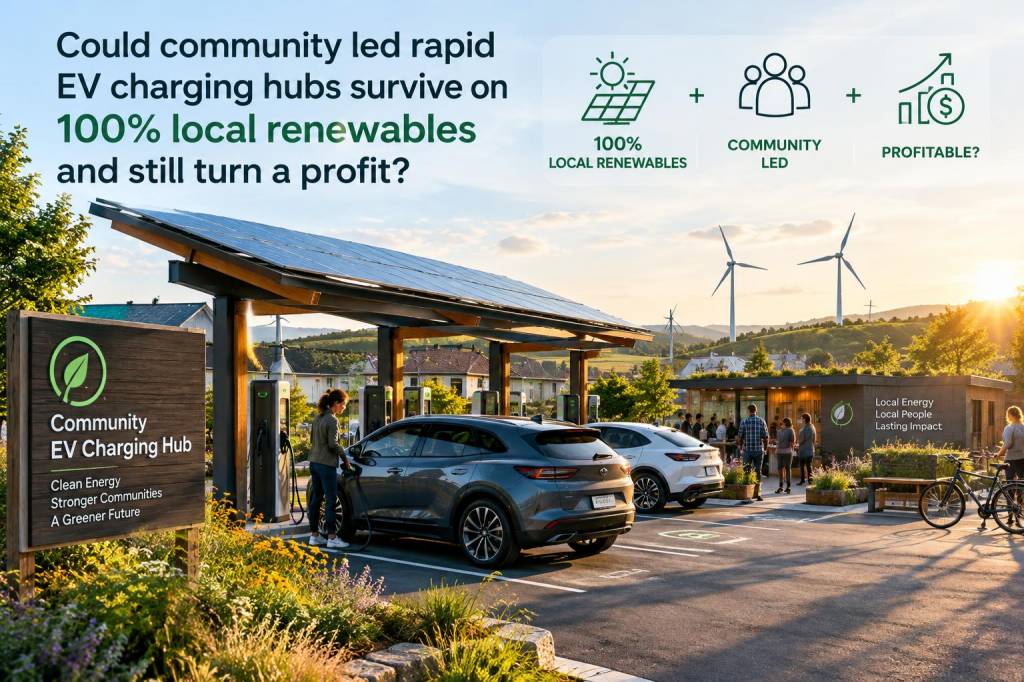
I’ve been thinking a lot about whether community-led rapid EV charging hubs can realistically run on 100% local renewables and still turn a profit. It’s an exciting idea: local people pooling resources to build charging infrastructure, powered by nearby solar, wind, or community battery storage. It feels like the kind of grassroots solution that could speed up the EV transition while keeping money and energy local. But there are practical, technical, and financial hurdles to navigate. Below I’ll walk through what I’ve learned, what works, where the gaps are, and some realistic models that could make this vision viable.
Why local, community-led charging hubs make sense
At their best, community-led hubs deliver multiple benefits:
I’ve seen projects where a parish council or community energy cooperative partners with a charging operator like Pod Point or EVBox, and the results can be transformative. But the ambition to power a hub solely with local renewables adds complexity.
Technical realities: generation, storage, and demand matching
Running a rapid charging hub (think 50–350 kW chargers) off 100% local renewables requires balancing three moving parts: generation, storage, and load. Here’s how each behaves:
In short, 100% local renewables is technically possible on a good day, but to guarantee it around the clock requires substantial overbuilding of generation, significant battery capacity, or demand flexibility that not all users will accept.
Economics: capex, opex, and revenue streams
Profitability depends on three levers: reducing capital costs, lowering operational expenses, and maximising revenue. Let me break them down.
Capital costs
Major upfront items include chargers, power electronics, site works, grid connection (if any), solar/wind generation, and battery storage. To give you a sense:
| Item | Typical cost range (approx) |
|---|---|
| 50–150 kW DC fast charger | £30k–£80k each |
| Commercial-scale battery (per MWh) | £300k–£600k/MWh (installed) |
| Solar PV (per kW) | £800–£1,200 |
| Grid connection upgrades | £10k–£100k+ |
For a modest community hub with two 150 kW chargers, 500 kW solar and 1 MWh battery, you could easily be looking at £500k–£1m capex. That’s significant, especially for community groups relying on grants and local fundraising.
Operational costs and revenue
Operational costs include maintenance, software/management fees, energy replacement (when local renewables are insufficient), insurance, and staff. Revenue comes from charging fees, potential grid services (frequency response, demand response), and ancillary income (coffee shop, retail on-site).
Business models that can work
From my experience, pure 100% local renewables plus standalone rapid chargers rarely achieve profitability alone. However, mixed models can:
Policy, grants, and community finance
Grants and soft finance are often essential. In the UK, schemes like the EV Chargepoint Infrastructure Grant (or its successors), local Net Zero funds, and community energy grants can bridge the gap. Community bonds or shares have also funded renewable projects — they create local ownership and can offer modest returns.
Crucially, regulatory frameworks affect profitability. Tariffs that reward exporting local solar are rare; more often, it is cheaper to export to the grid than to use that energy for a rapid charger at peak times unless you have storage. Changes to time-of-use tariffs, local flexibility markets, and supportive planning policy can tilt the balance towards community viability.
Real-world examples and lessons
I’ve visited a couple of community energy schemes that integrate EV charging. The successful ones share traits:
One project used a modest battery and large solar canopy over a car park. During the day, most charging was solar; in the evenings they imported grid power but offset annual emissions with certificates and community-owned renewables elsewhere. It wasn’t strictly 100% local renewables every minute, but it achieved strong local engagement and healthy finances.
So, can it be 100% local renewables and profitable?
Short answer: possibly, but rarely without concessions. To make it both fully local-renewables powered and profitable you typically need a combination of:
Absent those, a pragmatic hybrid approach — maximising local renewable use, providing grid backup, and stacking revenue — is the most repeatable pathway to making community-led rapid charging hubs sustainable economically and environmentally.
If you’re part of a community group thinking about this, I’d recommend starting with a robust feasibility study: model different generation mixes, battery sizes, and utilisation scenarios; engage local businesses for co-locating services; and explore every grant and partnership option. There’s no one-size-fits-all answer, but with smart design and community commitment, these hubs can be green, resilient, and financially viable.