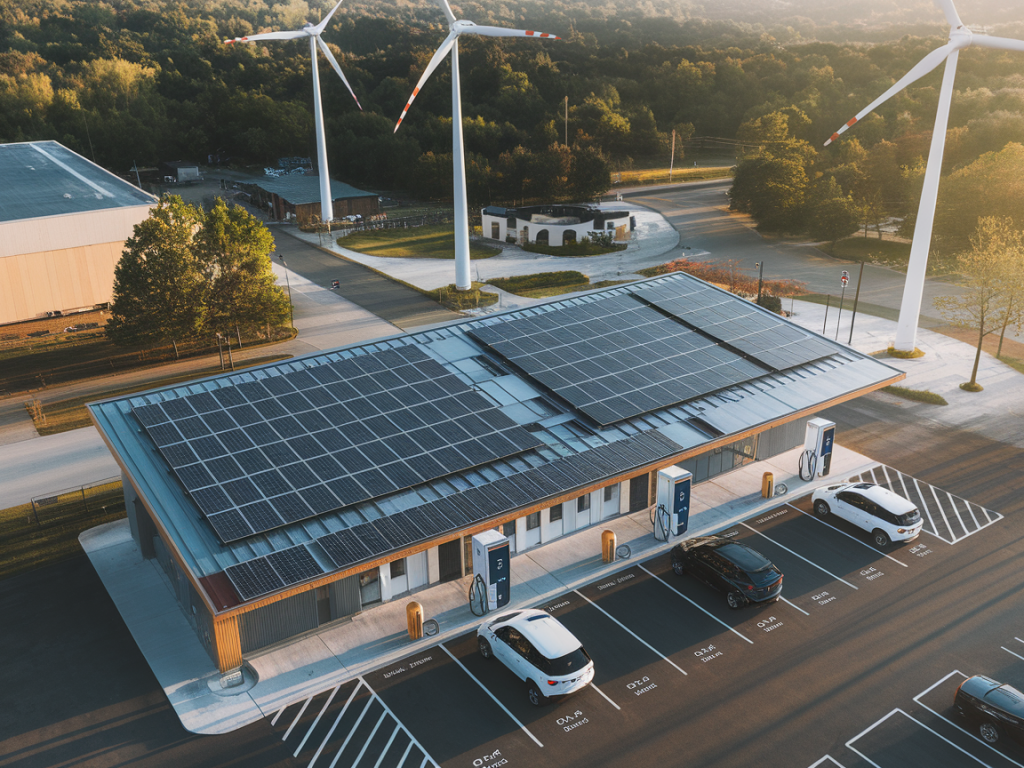
I often get asked whether rapid EV charging hubs can be powered entirely by local renewables and still make financial sense for small towns. It's a compelling vision: a main street charging station humming with fast chargers fed by a solar farm or a cluster of wind turbines, creating local jobs, lowering emissions, and keeping money in the community. In practice, the answer is nuanced—yes, it's possible in certain conditions, but it requires careful planning, smart financing, and the right technical setup.
What "entirely on local renewables" really means
When people say "entirely on local renewables," they usually mean that the energy consumed at the charging hub comes directly from generation located in or adjacent to the town—solar arrays, wind turbines, small hydro, or biomass—and not from grid-sourced fossil generation. There are a few ways to interpret that:
Each approach affects economics and deliverability in different ways.
Technical feasibility: generation, storage, and charging demand
Rapid chargers—particularly 150 kW to 350 kW units—draw a lot of power in short bursts. A single 150 kW charger at full power uses 150 kW every hour it's charging. If you host multiple chargers, peak demand quickly climbs into the megawatt range.
That makes on-site renewables alone challenging without two elements:
With a battery bank, you can charge the ESS slowly using solar or wind and discharge it quickly to supply several rapid chargers simultaneously. Batteries also solve intermittency: when the sun sets or wind drops, the stored energy keeps the station operational.
However, the required battery capacity and power rating can be expensive. For instance, supporting two 150 kW chargers with 30 minutes of simultaneous charging needs a battery capable of delivering around 300 kW continuous power and perhaps 150 kWh of energy—depending on assumed session lengths and depth of discharge.
Grid connection and hybrid setups
In many small towns, upgrading the local grid to handle repeated megawatt peaks is costly. A common, pragmatic model is a hybrid system:
This hybrid reduces demand charges (by lowering peak draw from the grid) and ensures reliability. Smart energy management systems coordinate EV charging, battery discharge, and renewable output to minimize grid dependency.
Costs and profitability
To assess profitability, I look at three main cost buckets:
| Item | Notes |
|---|---|
| Fast chargers | ~£50k–£150k per unit depending on power and site work |
| Battery Energy Storage | ~£300–£600/kWh installed depending on scale and balance of system |
| Solar PV | ~£700–£1,000/kW installed for commercial scale |
| Grid upgrades | Highly site-dependent; can range £10k to £1M+ |
Small towns typically have smaller traffic volumes than city hubs, which lowers revenues per charger. That means maximizing utilization is key: siting the hub near through routes, tourist areas, or retail hubs helps. Diversifying income—adding a cafe, convenience retail, or even hosting battery capacity for grid services—can make the business case stronger.
Business models that work for small towns
From my experience following projects around the UK and Europe, the following models often work best:
Each model trades off capital risk and revenue certainty. For instance, community ownership can capture most local economic benefits but may face funding challenges. PPPs reduce public risk but require clear contractual outcomes to ensure local priorities are met.
Policy, incentives, and de-risking options
Policy support can be decisive. Grants, capital subsidies, tax incentives, and low-interest loans de-risk projects. In the UK context, programs such as local authority funding streams, rural development grants, or Innovate UK competitions can significantly improve economics.
Another de-risking tool is long-term offtake agreements. If a municipality or anchor tenant (a logistics depot, bus operator, or supermarket) commits to a defined charging volume, financiers view the project more favorably.
Real-world examples and lessons
I've seen several notable examples that illustrate trade-offs:
Practical steps for towns considering this
If I were advising a town, I'd recommend these steps:
There’s no one-size-fits-all answer. For many small towns, running a rapid charging hub 100% on strictly local generation without any grid support is challenging and often uneconomic. But hybrid approaches—local renewables paired with battery storage and smart management, supported by grants or creative financing—can deliver near 100% renewable-sourced charging in practice while remaining financially viable.