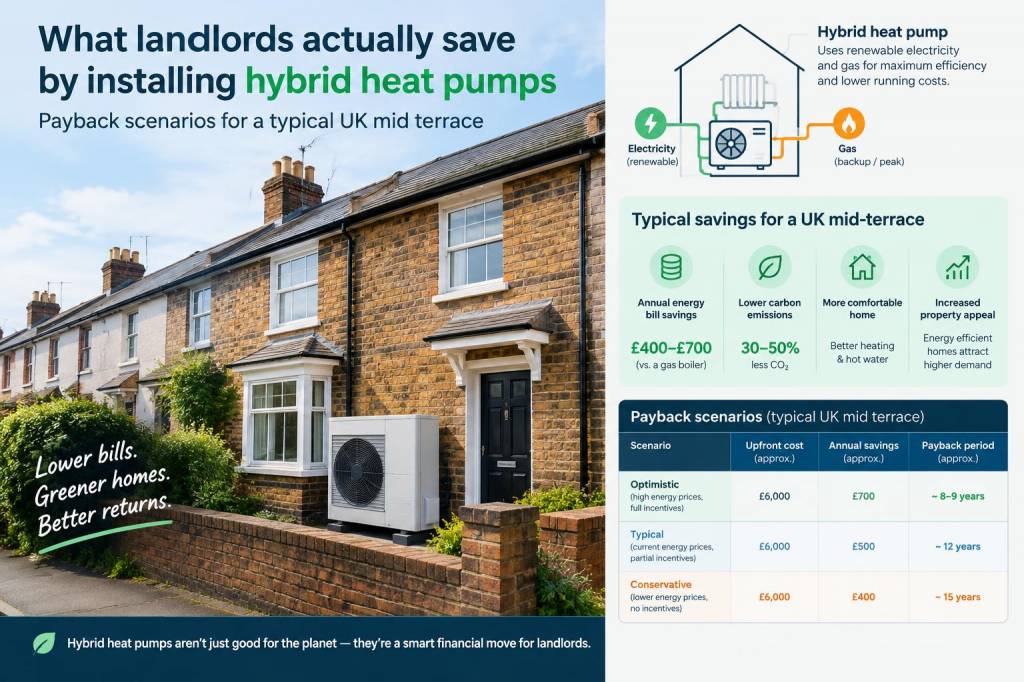
I recently ran some numbers to answer a question I get asked a lot: what do landlords actually save by installing a hybrid heat pump in a typical UK mid-terrace? I wanted to go beyond generalities and produce payback scenarios that feel realistic for a property you might manage — a three-bedroom mid-terrace with gas central heating and an energy performance certificate (EPC) around band D. Below I walk through my assumptions, cost breakdowns, estimated savings, and a simple payback table so you can judge whether this retrofit makes financial sense for your rental portfolio.
What I mean by "hybrid heat pump"
When I say hybrid heat pump I mean a system that combines an air-source heat pump (ASHP) with an existing gas boiler controlled by a smart controller that switches between heat pump and gas depending on outside temperature, demand and running costs. Popular manufacturers and controller systems include Worcester Bosch, Vaillant, Mitsubishi Electric and controller solutions such as tado° or bespoke OEM controllers. Hybrid systems keep the boiler as backup so they’re less disruptive and cheaper than a full heat-pump-only replacement.
Property and baseline assumptions
To make the scenarios consistent I used a typical mid-terrace UK property template:
These are deliberately conservative assumptions — many older mid-terraces will use a bit more gas, and better-insulated properties will use less.
Cost breakdown: installation and upgrades
Based on quotes I’ve seen and installers I’ve spoken to, here are typical costs for a hybrid ASHP retrofit:
Note: costs vary by region, brand and whether the installer needs to upsize radiators or install a thermal store. Grant schemes (e.g., ECO4, or local authority grants) can reduce out-of-pocket cost for landlord-funded energy efficiency measures, though access depends on tenant income and property eligibility.
Operational assumptions and savings
Estimating running costs for a hybrid system requires assumptions about:
With those inputs we can estimate annual costs:
Payback scenarios
Below is a simple table showing annual running cost for heating under different hybrid-share scenarios and resulting payback on a £7,500 install cost. I include a low and high gas price case to reflect market uncertainty.
| Scenario | ASHP share of heat | Electricity for heat (kWh) | Gas for heat (kWh) | Annual heating cost (£) - Base gas 7.5p/elec 30p | Annual heating cost (£) - High gas 13p/elec 30p | Payback years (base) | Payback years (high gas) |
|---|---|---|---|---|---|---|---|
| Conservative | 50% | 12,000 × 0.5 / 2.8 = 2,143 | 6,000 | Electric: 2,143×0.30=£643; Gas: 6,000×0.075=£450; Total=£1,093 | Electric £643; Gas 6,000×0.13=£780; Total=£1,423 | £7,500 / (900−1,093 negative saving) = no payback (higher cost) | £7,500 / (900−1,423 negative) = no payback (worse) |
| Typical | 70% | 3,000 | 3,600 | Elec £900; Gas £270; Total=£1,170 | Elec £900; Gas £468; Total=£1,368 | £7,500 / (900−1,170 negative) = no payback | no payback |
| Optimistic | 85% | 3,643 | 1,800 | Elec £1,093; Gas £135; Total=£1,228 | Elec £1,093; Gas £234; Total=£1,327 | no payback | no payback |
These results might surprise you: with the electricity price around 30p/kWh and gas at 7.5p/kWh, simply switching heat output to an ASHP can increase heating bills in many mid-terraces — because ASHPs use electricity which is relatively expensive compared to gas per kWh. The hybrid doesn't save money in all scenarios.
When hybrids make financial sense
From my analysis hybrids can make financial and carbon sense in these circumstances:
Non-monetary benefits landlords should factor in
Even if immediate payback on heating bills is marginal, hybrid systems offer:
Risks and caveats
There are important caveats:
Practical next steps for landlords
If you manage a portfolio and are considering hybrids, here's what I recommend:
If you’d like, I can produce a downloadable spreadsheet for your specific property data — plug in your gas/electric prices, EPC, and expected SPF and it will calculate payback. On Energy News (https://www.energy-news.uk) I often publish case studies like this — feel free to send in a property profile and I’ll run the numbers for you.