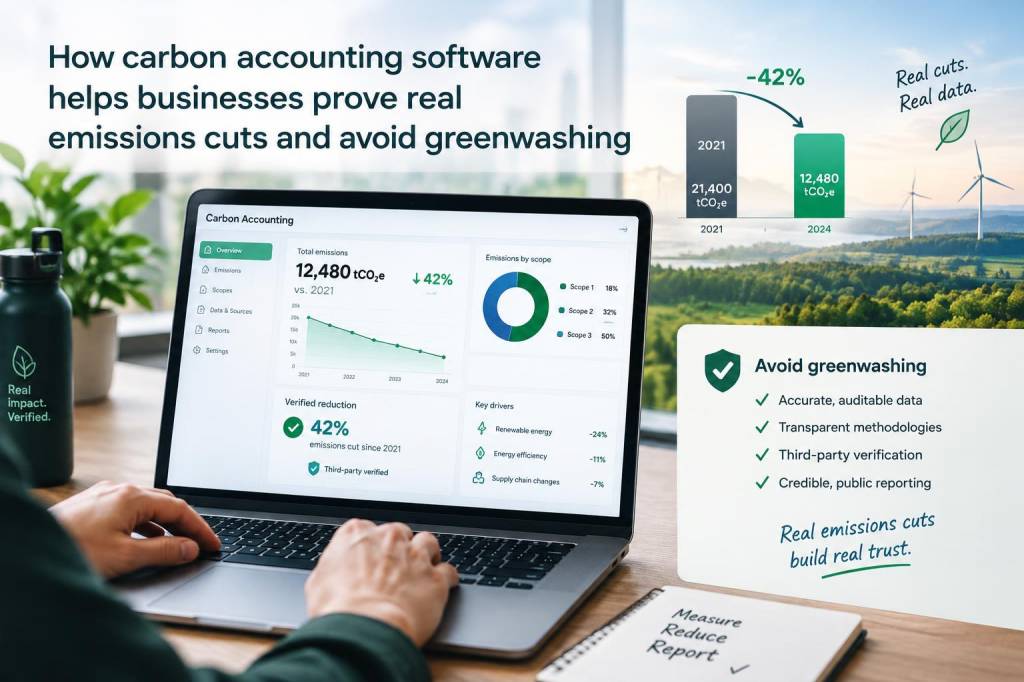
I have noticed a major shift in how businesses talk about emissions. A few years ago, many companies were satisfied with broad promises and polished sustainability statements. Today, investors, customers, employees, and regulators want something different: proof. They want to see real emissions cuts, not just ambitious language. That is where carbon accounting software has become so valuable to me. It gives organizations a structured way to measure emissions, track progress, and show evidence that their climate claims are grounded in data rather than marketing.
What I find most important is that carbon accounting is not only a reporting exercise. It has become a practical business tool. When I look at companies that use it well, I see a pattern: they move from vague commitments to clear action. They can identify where emissions come from, compare results over time, and separate genuine reduction from cosmetic changes. In a market where greenwashing can damage credibility overnight, that kind of clarity matters more than ever.
Why measurement matters before any claim
One of the biggest mistakes I see in sustainability communication is trying to promote results before measurement is strong enough to support them. A business may install efficient equipment, switch suppliers, or launch a low-carbon product line, but unless emissions data is collected carefully, it cannot confidently say what changed. Carbon accounting software helps solve that problem by creating a consistent system for data capture, calculation, and reporting.
From my perspective, this is where confidence starts. When a company can trace its emissions from energy use, logistics, purchased goods, travel, waste, and other sources, it can begin to understand its real footprint. That understanding is essential because carbon reduction is rarely linear. Some actions create immediate savings, while others take time to show results. Software makes those differences visible, which helps leaders avoid exaggerated public claims.
I have seen many businesses rely on spreadsheets for too long. Spreadsheets can work at a small scale, but they become fragile when a company grows or when reporting requirements become more demanding. Carbon accounting platforms reduce manual errors, make version control easier, and create an audit trail. That audit trail is one reason these tools are so useful in fighting greenwashing accusations: every number has a source, a method, and a history.
How carbon accounting software supports credible emissions claims
When I use carbon accounting software in a sustainability workflow, I look for one thing above all: traceability. A credible emissions claim should be backed by data that can be checked, explained, and repeated. Software supports this by linking activity data to emissions factors and by preserving the logic used in each calculation. That means a company can explain not only what changed, but why the change is real.
This matters in public reporting, investor communications, supplier conversations, and product marketing. If a business says it reduced emissions by 18 percent, stakeholders will want to know whether that figure reflects a genuine operational change or simply a temporary shift in purchasing, reporting boundaries, or market conditions. Carbon accounting software helps answer that question with evidence.
I also value the way these tools support scenario analysis. A business can estimate how different actions might affect future emissions, then compare those estimates with actual results later. That comparison is powerful. It shows whether a company is simply planning to decarbonize or truly executing a strategy that delivers measurable progress.
Some platforms also help companies align with recognized frameworks and disclosure requirements. That can include greenhouse gas inventories, science-based target tracking, and emissions reporting for supply chains. In my view, alignment with established methods is one of the strongest defenses against greenwashing because it reduces the temptation to invent custom metrics that sound impressive but lack comparability.
What I look for in a reliable platform
Not all carbon accounting software is equally useful. Over time, I have learned that a good platform should do more than produce reports. It should make emissions management easier for finance teams, operations teams, procurement teams, and leadership alike. If a tool is too complex, too rigid, or too disconnected from actual business processes, it can create frustration instead of clarity.
- Clear data structure for Scope 1, Scope 2, and Scope 3 emissions
- Transparent calculation methods with visible emissions factors and assumptions
- Audit-ready records so internal and external reviewers can verify results
- Integration options for energy, finance, procurement, and travel data
- Scenario planning to test reduction strategies before investment
- Supplier engagement features to improve upstream data quality
- Reporting outputs suited for boards, investors, customers, and regulators
In my experience, the strongest platforms also make it easier to track data quality over time. That is crucial. Early emissions data is often imperfect, especially for supply chains. A serious system does not hide that weakness. Instead, it shows where estimates are used, where primary data is available, and where improvement is needed. That honesty is a sign of maturity, not weakness.
Why greenwashing becomes easier without software
Greenwashing often happens not because a business intends to mislead, but because it lacks the systems needed to tell a complete and accurate story. A company might focus on a single impressive initiative while ignoring broader emissions growth elsewhere. It might celebrate a renewable electricity purchase without acknowledging rising logistics emissions. Or it might use a carbon offset claim to imply deep reduction when operational emissions remain high.
This is where carbon accounting software changes the conversation. By mapping emissions across the organization, it reduces the chance that leaders will overstate progress. It encourages a whole-organization view rather than cherry-picked messaging. I think that is one of its most valuable roles. It creates pressure for consistency between sustainability marketing and actual operational performance.
When a business uses software to monitor monthly or quarterly emissions, it can spot problems earlier. If emissions rise after a supply chain change, the team can respond before the issue turns into a public credibility problem. If a reduction project fails to deliver expected results, leaders can adjust their plans instead of presenting an inflated success story. In practice, that kind of visibility is what keeps sustainability communication grounded.
How I interpret real emissions cuts
For me, a real emissions cut is one that survives scrutiny. It should appear in the data over time, not only in a presentation. It should reflect an actual reduction in carbon intensity, energy use, fuel consumption, material demand, or supply chain impact. It should also be explainable in plain language. If a company cannot explain where the reduction came from, I become cautious.
I also pay attention to permanence. Some cuts are temporary, such as those caused by lower production volume or unusual market conditions. Others are structural, such as efficiency upgrades, electrification, renewable energy procurement, or redesigned logistics networks. Carbon accounting software helps distinguish between those cases. That distinction matters because stakeholders are increasingly skeptical of claims that look impressive in the short term but do not change the underlying business model.
Another issue I often notice is double counting. In complex organizations, several teams may want credit for the same reduction. Software helps prevent that by centralizing records and standardizing ownership. When emissions data is shared across departments, it becomes easier to assign responsibility and avoid inflated results. That discipline is important if a company wants to speak with authority about its climate progress.
Where this technology fits in business and marketing
Because this site focuses on business and marketing, I think it is worth saying plainly: sustainability claims are now part of brand trust. Customers are reading product labels, investors are examining disclosures, and business partners are asking sharper questions. A carbon accounting platform can help marketing teams communicate with more confidence, but only if they respect the data behind the story.
I prefer marketing that sounds measured rather than dramatic. When emissions results come from a reliable system, the message can be specific. A company can say it reduced emissions in a defined area, improved data quality across suppliers, or lowered energy intensity in operations. Those statements are stronger than broad environmental promises because they are tied to evidence.
Here is a simple comparison I often use when I think about this difference:
| Weak approach | Stronger approach |
|---|---|
| General climate promise with no measurement detail | Defined target supported by tracked emissions data |
| One-time sustainability announcement | Regular reporting with comparable results over time |
| Marketing claim based on partial evidence | Claim backed by auditable records and calculation methods |
| Focus on a single positive initiative | Full view of operational and supply chain emissions |
What I think businesses gain beyond compliance
Although compliance is a major reason companies adopt carbon accounting software, I do not think that is the only benefit. I have seen it improve internal decision-making in ways that go far beyond reporting. Finance teams can compare emissions with cost. Operations teams can identify waste. Procurement teams can evaluate suppliers more intelligently. Leadership teams can prioritize investments that reduce both carbon and risk.
That is why I see this software as a strategic asset rather than a reporting burden. It helps businesses understand where value is created and where emissions are being locked in. It also supports better conversations with stakeholders, because decisions can be explained with data instead of assumptions. In a business climate where trust is fragile, that is a major advantage.
Most importantly, it makes honesty easier. A company does not need to oversell its progress when it can show a clear record of what has been achieved, what remains uncertain, and what comes next. That kind of transparency is what separates credible climate action from empty messaging.