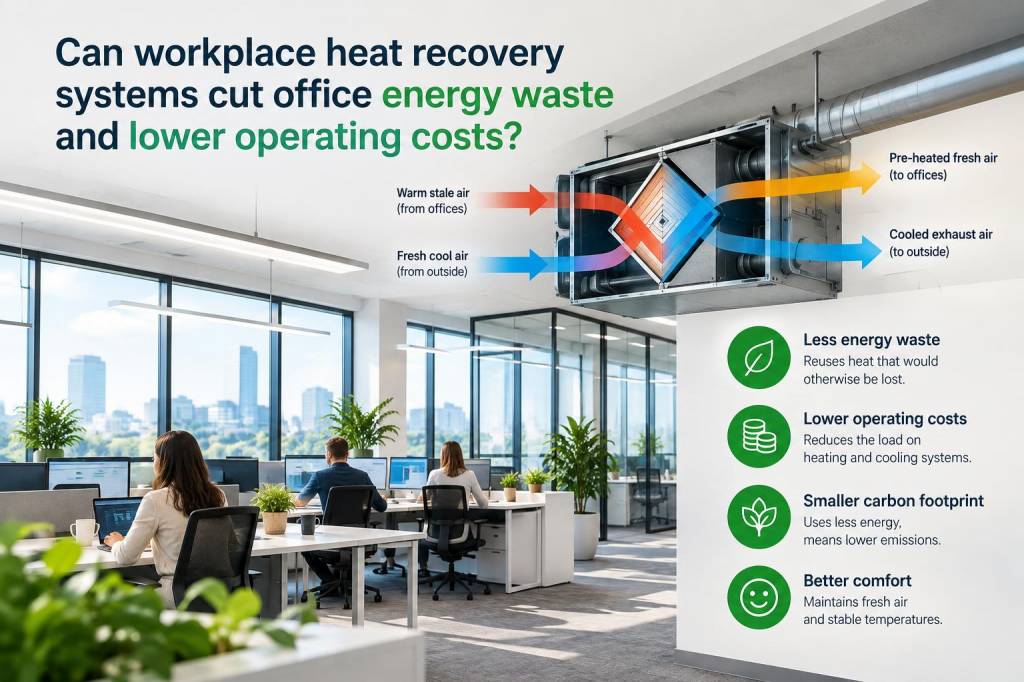
I have noticed a pattern in many offices: energy disappears in ways people rarely see. Lights get switched off, laptops sleep, but hidden waste still moves through ventilation shafts, server rooms, kitchens, washrooms, and mechanical plant spaces. One of the most overlooked opportunities I keep coming back to is workplace heat recovery. When I look at office buildings through an energy lens, I see a stream of warm air leaving the building while fresh air is brought in and heated again. That lost warmth is not just a technical detail. It is money, comfort, and carbon drifting away.
Heat recovery systems are designed to catch part of that waste and reuse it. In a modern office, that can mean transferring warmth from exhaust air to incoming air, or capturing heat from equipment and mechanical systems before it escapes. I think many people assume this is only relevant for large industrial sites, but offices can benefit in a very real way. In fact, because offices often run for long hours with steady occupancy, they can be a strong fit for heat recovery investments.
What I mean when I talk about workplace heat recovery
At its simplest, heat recovery takes energy that would otherwise be lost and uses it again. In office buildings, this usually happens through ventilation systems. As stale indoor air leaves the building, it passes through a heat exchanger that transfers part of its warmth to the incoming fresh air. The two air streams do not mix, but energy moves across the barrier.
I have seen this approach used in several forms. Some systems are built into air handling units. Others are added through energy recovery ventilators, plate heat exchangers, run-around coils, or heat pumps linked to waste heat sources. In some buildings, heat can even be recovered from server rooms, refrigeration units, domestic hot water systems, or process equipment used by onsite tenants.
The key idea is simple: if a building already spends money to create usable heat, then letting that heat vanish through exhaust air is a missed opportunity. Recovery systems reduce that loss and lower the demand on boilers, electric heaters, and other heating equipment.
Why office buildings waste so much energy
Office energy waste comes from more than one source, and heat loss is only part of it. Still, heat recovery is attractive because so much office energy demand is linked to ventilation and temperature control. I often think about three common causes.
- Fresh air needs rise with occupancy, which means more heating or cooling is required.
- Internal gains from computers, screens, printers, and people create heat that may be useful in one season and unwanted in another.
- Building systems often operate at full capacity even when actual use is uneven across floors, meeting rooms, or tenant zones.
In winter, this means a building may be warming incoming air again and again. In summer, it may be removing heat, only to dump conditioned air outdoors while the HVAC system works harder to replace it. A recovery system does not solve every inefficiency, but it can reduce the amount of energy needed to maintain comfort.
Where I see the strongest savings
When I evaluate potential savings, I usually start with buildings that have stable schedules and significant ventilation needs. Open-plan offices, corporate headquarters, call centers, shared workspaces, and multi-tenant commercial buildings can be strong candidates. Buildings with large meeting spaces or high outside-air requirements may also gain a lot.
The largest savings often come from replacing separate heat input with recovered heat. If a building can preheat incoming air using exhaust air, the heating system has less work to do. That can lower gas use, reduce electric heating demand, and smooth peak loads. In some cases, heat recovery can also support cooling strategies by reducing the load on chillers and helping maintain more stable indoor conditions.
I also pay attention to year-round operation. An office that runs ventilation systems for long hours, even when occupancy is partial, can waste a surprising amount of energy. Heat recovery works especially well when air changes are required regardless of weather, because it turns a necessary ventilation function into an energy source.
What determines whether it is worth doing
Not every building will benefit in the same way. I always look at a few practical factors before I consider the business case strong.
| Factor | Why it matters |
|---|---|
| Climate | Colder locations usually get stronger heating savings, while mixed climates may benefit in both heating and cooling seasons. |
| Ventilation rate | Higher fresh-air demand usually means more recoverable energy. |
| Building layout | Long duct runs, multiple zones, and separated air paths can affect system design and efficiency. |
| Operating schedule | Long daily use and steady occupancy improve payback potential. |
| Maintenance access | Filters, heat exchangers, and sensors need regular care to preserve performance. |
One thing I have learned is that the technical savings are only part of the story. A project also needs good controls, proper commissioning, and real attention to maintenance. If filters clog, fans drift out of tune, or bypass controls are set poorly, performance can fall fast. Heat recovery is only as good as the system management around it.
How I think about operating cost reductions
Lower operating costs come from several directions at once. First, there is less direct heating energy required. Second, the HVAC system may run more efficiently because it does not need to work as hard to meet supply air temperature targets. Third, better thermal balance can reduce wear on boilers, heat pumps, chillers, and fans.
That last point matters more than many people expect. I like energy-saving measures that affect not only utility bills but also maintenance and equipment life. When a system is under less stress, it may last longer, require fewer repairs, and create fewer comfort complaints. In a business context, that means fewer disruptions for staff and fewer emergency service calls.
There is also a financial angle linked to energy price volatility. If a building can rely less on purchased heat, it becomes a little less exposed to market swings. For many organisations, that kind of stability is valuable even when energy prices are not at their highest.
Comfort matters just as much as efficiency
I do not think office energy projects should be judged only by utility savings. People spend many hours in these spaces, and comfort affects focus, satisfaction, and productivity. Heat recovery can help create more stable indoor temperatures and reduce the cold drafts that sometimes appear when fresh air is brought in without preheating.
I have seen office teams complain about rooms that feel too cold near windows and too warm in meeting rooms. While heat recovery is not a cure for every comfort problem, it can support more even conditions across the building. In winter, preconditioned fresh air can feel less harsh. In shoulder seasons, balanced ventilation can reduce the temptation to overheat parts of the building just to satisfy a few cold spots.
That balance is important because comfort complaints often lead to energy waste. People bring in portable heaters, open windows at the wrong time, or ask for setpoints to be pushed higher than necessary. A better-designed system can reduce those responses before they start.
Where technology is moving now
I find the current generation of heat recovery technology more interesting than older systems because it is getting smarter and more integrated. Building management systems can now monitor temperatures, airflow, pressure, and occupancy with much better precision. That means recovery systems can respond dynamically instead of operating in a fixed, one-size-fits-all mode.
Some newer setups combine heat recovery with demand-controlled ventilation, which adjusts fresh air based on occupancy or air quality. That pairing can be powerful. If fewer people are in the building, the system does not need to move as much air, and the recovered heat can still be used more efficiently. I also see more interest in hybrid systems that combine heat recovery with heat pumps, especially in buildings moving away from fossil-fuel heating.
For office owners and facilities teams, this opens up a practical question: not just whether to recover heat, but how to do it in a way that matches the building’s actual use pattern. That is where design quality makes a huge difference.
What I would check before investing
If I were assessing an office building for heat recovery, I would want a clear picture of the following:
- Annual heating and cooling demand
- Fresh-air requirements by zone
- Existing HVAC age and condition
- Fan energy use and duct resistance
- Available space for equipment and maintenance access
- Indoor air quality targets
- Expected occupancy patterns across weekdays and seasons
I would also want to understand the tenant mix. A building with data-heavy users, server rooms, cafes, or high-density teams may produce recoverable waste heat in more than one location. In some cases, that heat can be redirected to other parts of the building instead of being rejected outdoors. That kind of internal energy sharing is one of the most elegant efficiency strategies I know.
Why this matters for office strategy now
From a business perspective, heat recovery fits into a broader shift in how organisations think about energy. Office managers are no longer asking only whether a building is warm enough. They are asking whether it is affordable, resilient, and aligned with carbon targets. Heat recovery answers all three questions to some degree.
I see it as a practical measure rather than a flashy one. It does not need dramatic behavior change from staff, and it does not depend on constant human attention. Once properly designed and maintained, it quietly works in the background, reducing waste every day. For businesses focused on operational efficiency, that quiet reliability is part of the appeal.
When I step back and look at the bigger picture, I see workplace heat recovery as one of those measures that turns a hidden loss into a useful asset. It is not magic, and it is not suitable for every building, but in the right office it can reduce energy waste, ease operating costs, and improve comfort at the same time.