I get asked a lot: "Will perovskite solar roofs survive UK weather, and what real performance can I expect?" It's a fair question. After years covering renewables and talking to researchers, installers and early-adopter homeowners, I’ve formed a practical view that balances excitement with realism. Below I’ll walk you through how perovskite technologies behave in the real world, what stresses UK roofs put on them, how manufacturers are responding, and the kind of energy you might actually see from a perovskite roof in Britain.
What are perovskite solar roofs and why they matter
Perovskites are a class of materials (not just one compound) that have shown rapid performance gains in labs. Their appeal is huge: low-cost manufacturing, light weight, flexibility, and strong performance in low-light conditions — all attractive for roofs that face north, are shaded, or have complex geometry. Companies such as Oxford PV have been developing perovskite-silicon tandem cells aiming for higher efficiencies, while others like Saule Technologies focus on flexible perovskite films for building-integrated photovoltaics (BIPV).
UK weather: the main durability challenges
When we talk about "surviving UK weather", we're really talking about a handful of environmental stresses:
Perovskite materials are inherently more sensitive to moisture and heat than crystalline silicon. Early formulations degraded quickly when exposed to water or heat. The real progress in the last 5–7 years has been in packaging and chemistry — making perovskites that can survive these stresses much better than before.
Encapsulation: the make-or-break factor
If you want perovskite roofs to last in the UK, encapsulation is critical. Good encapsulation does three things: keeps moisture out, blocks oxygen, and filters damaging UV where necessary. Typical approaches include glass-glass laminates, polymer barrier films and edge seals with desiccants. For BIPV roof elements, manufacturers are using thicker, multi-layer encapsulants and robust edge sealing to meet outdoor longevity demands.
Manufacturers running IEC-type accelerated tests (e.g., damp heat 85°C/85% RH, thermal cycling, UV exposure) and then validating with real-world outdoor exposure in different climates are the ones I watch closely. The industry has moved from passing only basic lab tests to running extended protocols because investors and homeowners demand 20–25 year lifetimes comparable to silicon.
What real-world performance looks like in the UK
Here are practical pointers about energy yields and expected degradation:
To put numbers on energy yield, a typical well-installed silicon rooftop system in the UK delivers roughly 800–1,100 kWh per kWp per year depending on location (lower in the north and on north-facing roofs). A perovskite roof of equivalent rated power might:
| Scenario | Estimated annual yield (kWh/kWp) |
| Sunny south-facing, minimal shading | 900–1,200 |
| East/west or partially shaded | 850–1,050 (perovskite may outperform silicon modestly) |
| North-facing or very diffuse-light sites | 700–950 (perovskite low-light edge helps) |
These are indicative ranges — real results depend on roof orientation, tilt, local microclimate, and the exact module type. The key point: perovskites could match or outperform silicon in many UK scenarios, especially where low-light performance matters, but long-term degradation remains the biggest uncertainty.
Installation, maintenance and roof integration
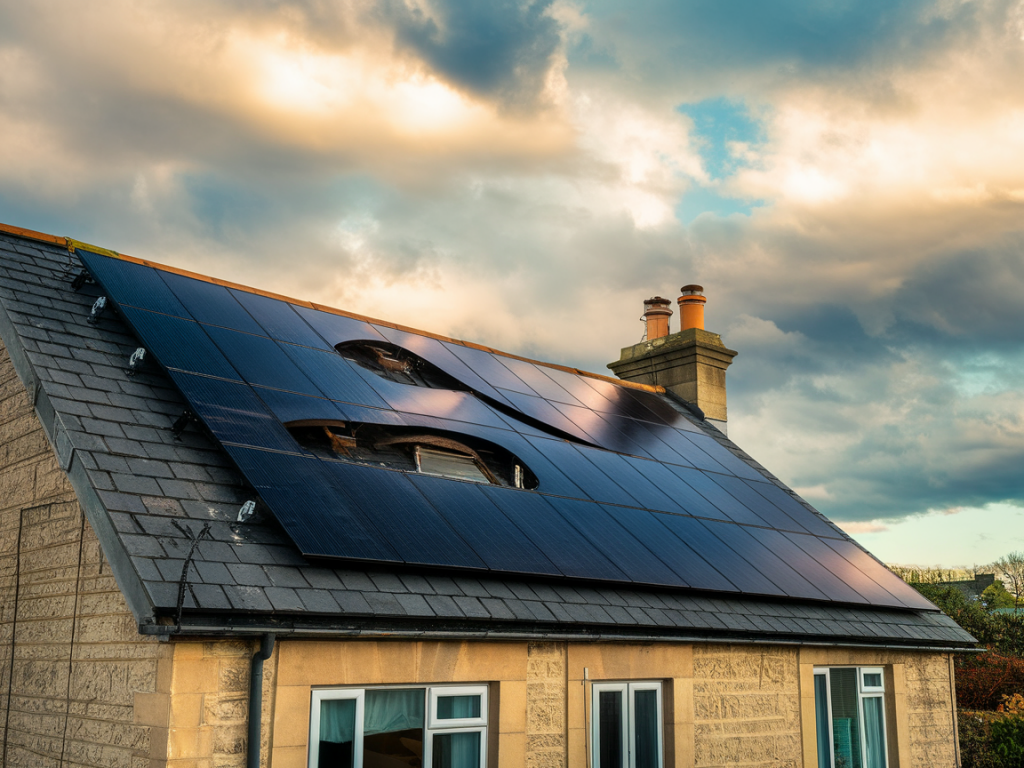
Perovskite BIPV products often come as lighter-weight tiles or flexible laminates, making them easier to integrate on some roof types. That said, installation quality is paramount: edge sealing, flashing details and preventing ponding or trapped moisture are crucial. You want an installer experienced with the specific product and the building-integrated nature of the module — poor installation is the fastest path to premature failure.
Maintenance is generally low: clean panels occasionally, keep gutters and roof valleys free from debris, and inspect edge seals after severe storms. Watch for early signs of delamination or staining — those are red flags that can indicate moisture ingress.
Warranties, standards and what to ask before buying
If you're considering a perovskite roof, ask manufacturers and installers for:
Until the technology has a decade or more of field validation in northern European climates, many homeowners hedge by combining perovskite sheets in BIPV applications or choosing perovskite-silicon tandems from established manufacturers that can back warranty claims with proven supply chains.
Brands and market reality
You’ll hear names like Oxford PV (tandem cells), Saule Technologies (flexible films) and several startups commercialising BIPV elements. Big module producers are also exploring perovskite tandems — a sign that the tech is moving from lab to market. But product maturity varies. For critical rooftop investment, I recommend looking for manufacturers that can show third-party verification and long-term pilot results in climates similar to the UK.
Personally, I’m optimistic. Perovskite roofs address real limitations of silicon in many roof contexts and could accelerate BIPV adoption across urban areas. But right now the sensible stance is pragmatic: perovskite roofing can work very well in the UK if you choose reputable products, insist on robust encapsulation and careful installation, and accept that warranties and long-term field data will still be evolving over the next 5–10 years.