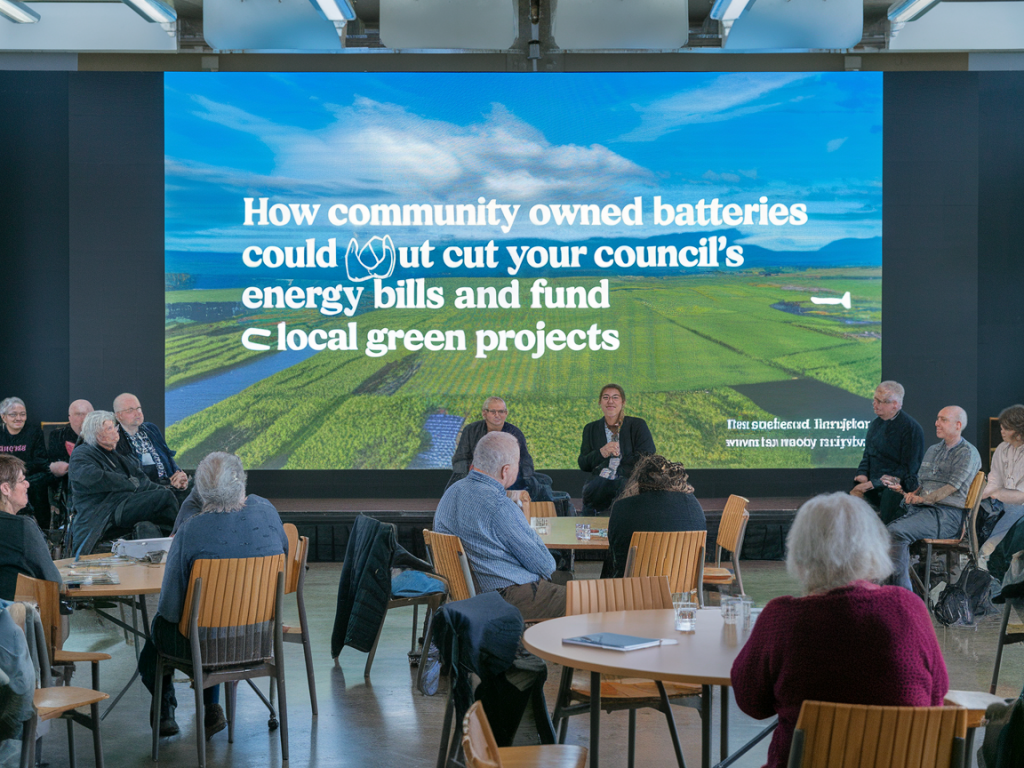
I’ve been watching community energy projects evolve for years, and one development that keeps catching my attention is community-owned batteries. These systems are more than a technical novelty — they’re practical tools councils can use to shave energy costs, stabilise local grids, and create revenue streams for green projects. In this piece I want to unpack how they work, what councils need to know, and why they often make more sense than people expect.
What is a community-owned battery?
A community-owned battery is a large-scale battery energy storage system (BESS) owned and managed by a local authority, community group, or a cooperative. Unlike rooftop batteries on private homes, these installations are sized to serve public buildings, street lighting, EV chargers, and even households nearby. They store energy when it’s cheap or abundant (for example, from solar farms or during low demand at night) and discharge when prices spike or when local demand is high.
How can they cut a council’s energy bills?
There are several direct ways a council can save money:
- Peak shaving — Batteries discharge during high tariff periods, reducing peak demand charges. For many councils, peak demand penalties are a significant portion of the electricity bill.
- Buy low, use high — By charging batteries during overnight low-price periods and discharging during expensive daytime hours, councils can lower their wholesale purchase costs.
- Maximise solar self-consumption — When a council already has solar PV on schools or depots, batteries allow storage of excess generation instead of exporting it at low feed-in tariffs.
- Reduce network charges — Strategic local balancing can avoid costly grid reinforcements or reduce capacity charges allocated to the council’s sites.
What are the typical savings?
Savings depend on scale, tariff structure, and how actively the battery is managed. A practical example I’ve seen: a mid-sized council with a 500 kWh battery cut its annual energy spend for a cluster of public buildings by around 15–25% in the first full year once the system was optimised. Those savings often increase when batteries participate in ancillary services or flexibility markets.
| Metric | Without Battery | With Battery |
|---|---|---|
| Annual energy cost (example) | £250,000 | £190,000 |
| Peak demand charge | £40,000 | £20,000 |
| Net savings | — | ~£60,000 (24%) |
How can a battery fund local green projects?
Beyond operational savings, batteries can generate income or free up budget lines that can be reallocated:
- Market participation — Batteries can be dispatched into frequency response or other flexibility markets (e.g., via providers like National Grid ESO in the UK), earning payments for services that stabilise the grid.
- Commercial contracts — Councils can partner with energy companies to share revenue from trading the battery’s capacity.
- Leasing space — Local councils can rent roof or land to host batteries for third parties in return for income or reduced energy bills.
- Grant-funded pilots — Initial installations are often eligible for government or regional grants; subsequent operational savings can be ring-fenced for green initiatives such as tree planting, retrofits, or EV infrastructure.
What governance and ownership models work best?
There isn’t a one-size-fits-all model. I’ve seen several successful approaches:
- Council-owned and operated — Maximum control and capture of savings, but requires in-house expertise or outsourced O&M (operation & maintenance).
- Community cooperative — Strong public buy-in; revenue can flow directly to community projects. Requires robust governance to manage members’ expectations.
- Public-private partnership — Private firm finances and runs the battery; council secures a long-term energy services agreement. Good for councils with limited capital.
What are the main challenges?
Deploying community batteries is not without hurdles:
- Upfront cost — Batteries and associated power electronics can be expensive, though costs have fallen dramatically over the last decade.
- Regulatory complexity — Participation in markets like frequency response, constraint management, or local flexibility requires navigating rules and sometimes accreditation.
- Technical integration — Sizing, siting, and control strategies must align with local generation profiles, demand patterns, and network constraints.
- Degradation & lifetime — Batteries lose capacity over time; financial models must account for replacement or repurposing strategies.
What technologies and suppliers should councils consider?
Several reputable battery and energy management providers operate in the UK and Europe. Brands like Tesla (Powerpack), Fluence, and LG Energy Solution have proven BESS platforms. Equally important is the Energy Management System (EMS) — companies such as Moixa, Kiwi Power, and Open Energi specialise in intelligent orchestration and market access. My recommendation: assess both hardware reliability and software optimisation capabilities — the latter often determines the long-term returns.
How do councils get started?
Here’s a pragmatic roadmap I’d suggest:
- Conduct an energy audit to identify clusters of sites and load profiles.
- Run a pilot (100–500 kWh) to test control strategies and market participation.
- Explore funding: Public grants, green bonds, or partnerships with local housing associations or energy companies.
- Engage the community early to build support — community ownership or benefit-sharing schemes increase social licence.
- Partner with experienced integrators who can navigate grid connections, contracts, and optimisation.
What about battery recycling and safety?
These concerns are valid. Modern BESS installations follow stringent safety standards (e.g., BS/IEC standards) and include fire suppression, thermal management, and monitoring. End-of-life planning is critical: many suppliers now provide battery take-back or recycling services, and second-life applications (less demanding uses) can extend economic value before recycling.
Real-world examples worth watching
Projects like Brighton & Hove’s community energy initiatives and Western Power Distribution’s trials of local flexibility show how batteries can be integrated at scale. Smaller councils have partnered with companies such as Octopus Energy and EDF to pilot municipal batteries combined with solar and EV charging. Each case highlights the importance of local context — what works in one town may need adaptation elsewhere.
Ultimately, community-owned batteries are more than a line item on a balance sheet. They’re flexible assets that, when deployed thoughtfully, reduce bills, increase energy resilience, and create tangible returns that can be reinvested in the local transition. If your council is exploring ways to finance retrofits, EV rollout, or community programmes, batteries deserve a close look.