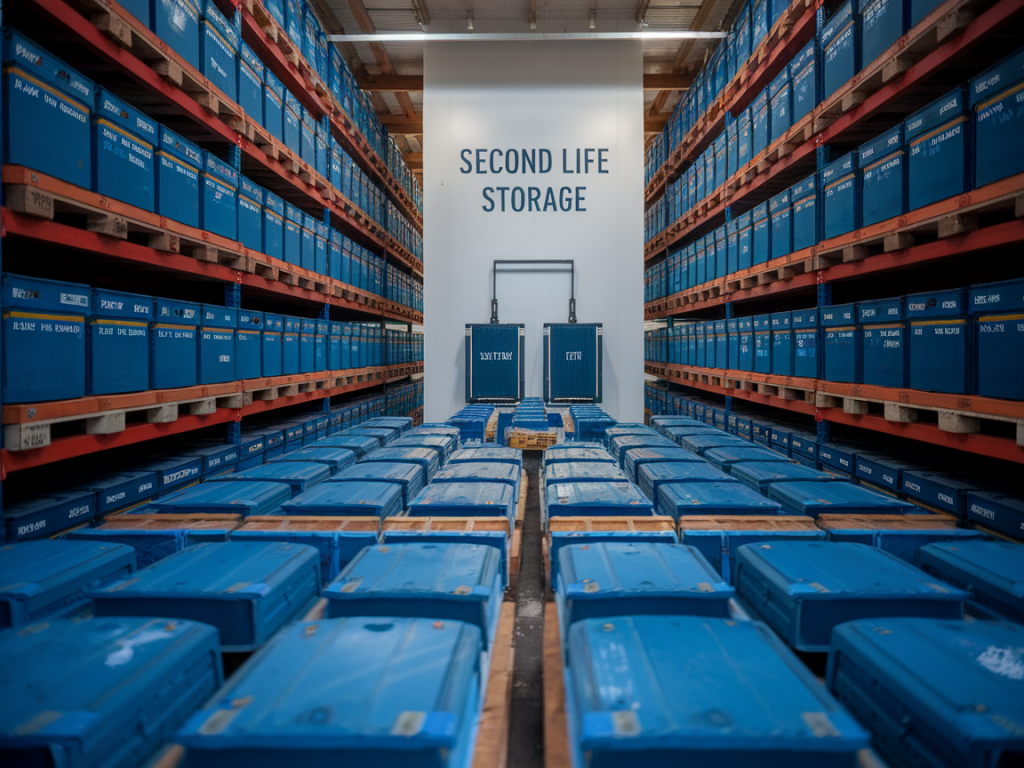
After a decade behind the wheel, what actually happens to an EV battery is a question I get asked all the time. People imagine drama — cars stranded on the roadside, batteries melting down, or, on the flip side, perfectly healthy packs languishing in scrapyards. The reality sits somewhere in between, and it opens up a really practical opportunity for households: second-life energy storage. Let me walk you through what I’ve learned in the field, what “end of life” really means for EV packs, and how reusing them can lower your home energy bills.
What “after 10 years” usually looks like for EV batteries
Battery chemistry and degradation depend on many things: the cell type (NMC, LFP, etc.), how the car was driven, charging habits, climate, and even the vehicle’s battery management software. But after roughly 8–12 years most EV battery packs commonly retain about 60–80% of their original capacity. That doesn’t mean the battery is dead — it just means it can store less energy than when new.
Here are typical outcomes I’ve seen and read about:
Why these “worn” batteries are perfect for second-life storage
For a car, usable range is a premium. Drivers want consistent range and fast charging. But for stationary energy storage — balancing solar output, shifting consumption to cheaper periods, or providing backup power — the requirements are far less demanding. A pack with 65% of original capacity can still provide many useful kilowatt-hours of storage at a fraction of the cost of new batteries.
Second-life applications make sense because:
How second-life storage systems are built
Re-purposing an EV pack isn’t just unplug-and-plug-in. It requires testing, reconditioning, and suitable electronics. Companies like Relectrify, Nissan, and startups across Europe and Japan have developed processes to:
Some manufacturers, notably Nissan with early Leaf batteries, have piloted second-life projects where retired car packs power factories or homes. Tesla’s battery architecture and software make reuse more complicated, but even there, innovative companies are exploring module-level solutions.
What households can realistically expect in savings
Let me give you a practical example. Assume you buy a second-life battery offering 10 kWh of usable capacity (after accounting for depth-of-discharge limits). If you charge it with rooftop solar and use it to shift 8 kWh of consumption per day from peak electricity (say 25p/kWh) to solar (effectively 0–5p/kWh), your daily saving could be roughly:
| Shifted energy | 8 kWh/day |
| Price delta | 20 p/kWh |
| Daily saving | £1.60 |
| Annual saving | ~£584 |
If the cost of the second-life system (installation included) is around £3,000–£4,500, you’re looking at a simple payback of 5–8 years depending on electricity prices and how you use it. That can be substantially faster if you pair storage with time-of-use tariffs or if energy prices rise.
Benefits beyond direct bill savings
Challenges and things to watch for
Second-life storage is promising but not without hurdles, and I make sure to highlight these when people ask me whether they should adopt one.
Real-life examples and models
I’ve seen households in the UK and Europe benefit from projects that reuse Nissan Leaf batteries. In some community energy schemes, a few retired packs are combined into a larger storage array that smooths local solar production, providing both resilience and revenue by participating in demand response programs.
On the commercial side, systems built from Renault ZOE batteries were used to store energy at factory sites, offsetting peak charges. Some utilities and aggregators are also exploring fleets of second-life units as cheap distributed flexibility assets.
How to assess if second-life storage is right for your home
Here’s a quick checklist I recommend people run through:
The market is moving quickly. Prices for new lithium-ion storage are still falling, and standards for second-life batteries are improving. But for many households today, especially those with solar PV, a well-documented second-life battery can be a cost-effective, lower-carbon way to cut bills and get more control over energy use.