Green Innovation

How to build a street-level microgrid with second-life ev batteries and community tariffs

How to build a street-level microgrid with second-life ev batteries and community tariffs

When I first started exploring the potential of second-life EV batteries for community energy projects, I imagined quiet streets powered during peak hours by batteries that once propelled electric cars. That vision turned into a practical project idea: a street-level microgrid combining rooftop solar, second-life batteries from fleet EVs, and a community tariff that makes participation financially attractive. In this article I’ll walk you through how I would design and build such a system, the technical and business considerations to keep in mind, and some lessons learned from pilots and suppliers on the market.

Why second-life EV batteries and why at street level?

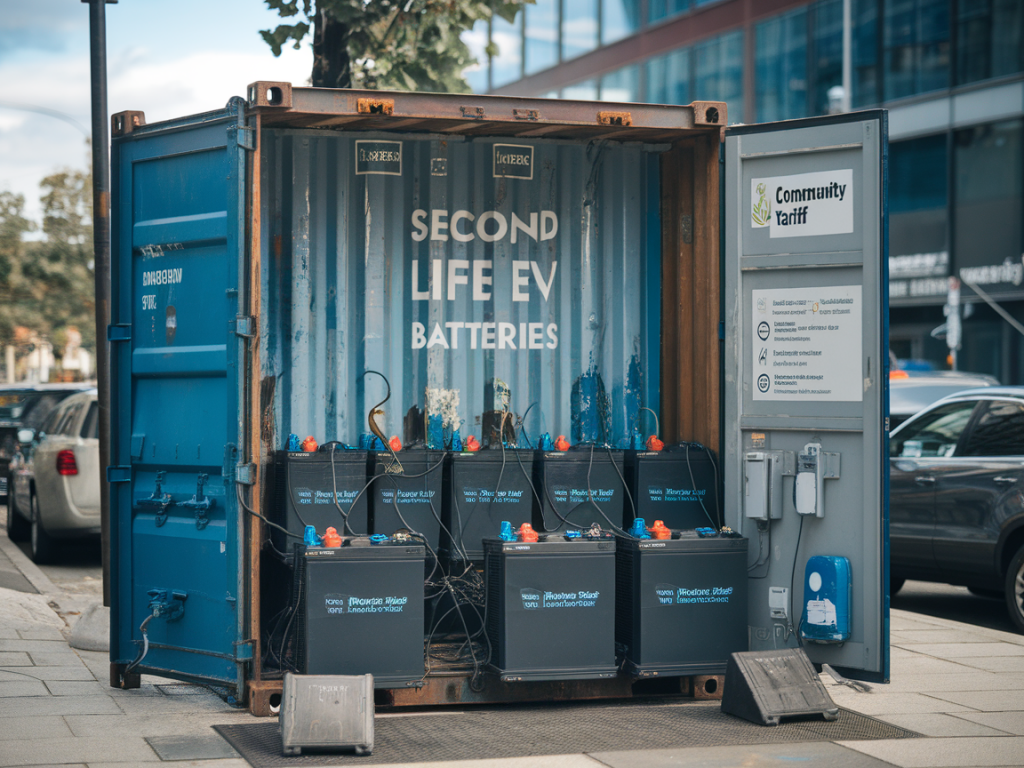
Second-life EV batteries are an appealing resource because they offer a large-capacity, low-cost energy storage solution once their capacity falls below automotive needs (typically ~70–80%). Repurposing these packs delays recycling, reduces lifecycle emissions, and sharpens the economics of local energy storage. Placing microgrids at street level—serving a row of homes, a small shopping strip, or a community hub—lets us optimize energy flows locally, reduce distribution losses, and implement tailored tariffs that reflect the actual value provided to residents.

Core components of the street-level microgrid

At minimum I include the following elements:

  • Distributed generation: rooftop solar PV on homes and public buildings, and possibly small-scale wind if viable.
  • Second-life EV batteries: containerized or modular battery systems located on street-facing verges, in small cabinets, or in a community centre.
  • Power electronics: inverters, DC-DC converters, battery management systems (BMS) adapted for second-life cells, and protective switchgear.
  • Energy management system (EMS): software that orchestrates charging/discharging, demand response, and the community tariff logic.
  • Metering and communications: smart meters at each participating premises and secure comms (LoRaWAN, cellular, or wired) to the EMS.
  • Sourcing and preparing second-life batteries

    I’ve worked with a few battery recyclers and EV fleets. The typical path is:

  • Partner with fleet operators (taxi firms, delivery companies, car rental companies) who rotate EV packs on regular intervals.
  • Perform an audit and testing program: capacity tests, IR tests, cell balancing checks, and thermal behaviour assessments.
  • Remanufacture into standardized modules: repack cells into containerized racks with an appropriate BMS and cooling.
  • Certify and warranty: obtain safety testing (UN38.3, IEC 62619 equivalent tests where possible) and provide at least limited warranty to reassure host communities.
  • Some companies to watch include Northvolt (for recycling/second-life research), Leclanché, and startups focused on BESS repurposing like EVeBattery or Gridtential. But many local players might provide better supply depending on your country.

    Sizing the system

    Sizing is both an energy and a power problem. I start with:

  • Load profiling: gather smart meter data (or estimated profiles) for the target street for at least one year if possible to capture seasonality.
  • Solar generation estimate: map the available roof area and use irradiance models to predict PV output.
  • Cycle design: decide the use-case: peak shaving, backup power, load shifting, or a mix. This drives the battery capacity and power ratings.
  • A simple rule-of-thumb I often use: for peak shaving on a residential street of 20 homes, 100–200 kWh of usable battery storage (which might be 125–250 kWh nameplate for second-life packs) with 50–100 kW inverter capacity can have a significant impact. But always model with local data.

    Community tariffs: making the economics work

    The tariff design is the glue that connects hardware to people. I believe tariffs should be simple, transparent, and aligned with local grid costs. Some approaches I recommend:

  • Time-of-use credit: participants receive cheaper energy from the microgrid during peak periods and pay a premium when exporting to the grid.
  • Subscription + usage: a modest fixed monthly fee to cover capital recovery plus a variable per-kWh charge based on the microgrid supply price.
  • Export sharing: when the microgrid exports to the main grid at high prices, revenues are split between the community fund and participating households.
  • Priority access tiers: households can opt for higher-priority supply (useful for medical needs) at a slightly higher fee.
  • When designing tariffs, I simulate annual cash flows including avoided grid charges, capacity benefits, FiT or export tariffs, and potential resilience value. In many places, the microgrid can pay back capital within 5–8 years when batteries are low-cost and tariffs capture peak value.

    Control strategy and safety

    My EMS prioritizes safety and longevity:

  • Battery state-of-health (SoH) and state-of-charge (SoC) management keeps cycles shallow (e.g., 20–80%) to extend life.
  • Forecast-aware optimisation uses short-term solar and load forecasts to schedule charging/discharging.
  • Island capability: in outage scenarios, the microgrid can form an island and sustain critical loads for a defined duration.
  • Standards compliance: follow local distribution code, IEEE 1547 (or equivalent), and battery safety standards. Anti-islanding, fault ride-through, and rapid shutdown protocols are essential.
  • Business models and governance

    I’ve seen several successful governance structures:

  • Cooperative ownership: residents buy shares in the microgrid and receive dividends from exported energy and savings.
  • Third-party operator: an ESCO installs and operates the system, charging a management fee while sharing savings with the community.
  • Municipal partnership: local councils provide permits, site leasing, and sometimes funding; a private operator runs the system.
  • For community acceptance, transparency is crucial: publish expected savings, performance dashboards, and a clear terms-of-service. Insurance and liability clauses need to be explicit, especially with second-life batteries.

    Costs, revenue streams and a quick comparison

    ComponentEstimated cost (indicative)Revenue/Value
    Second-life battery (per kWh installed)£80–£150Energy arbitrage, peak avoidance
    Inverter + BMS (per kW)£150–£350Enables grid services, export
    EMS + metering£5k–£20k (system)Tariff management, optimization
    Installation & civils£10k–£50kSite readiness, safety

    These numbers vary widely by location, but the key is layering revenue: household savings, grid service payments (if available), export income, and resilience value.

    Regulatory and permitting hurdles

    Don't underestimate local grid rules. I spend time early on discussing with network operators to clarify export limits, anti-islanding requirements, and whether aggregated assets can participate in ancillary service markets. Permitting for second-life batteries can be complex: some jurisdictions treat them differently from new batteries. Engaging the local fire service and using certified enclosures simplifies approval.

    Pilots and practical tips

    From pilots I’ve seen, success favors projects that:

  • Start small with a clear use-case (e.g., peak shaving for a commercial strip).
  • Engage residents early and show tangible performance dashboards.
  • Offer flexible participation—opt-in for tariff tiers rather than mandatory charges.
  • Keep maintenance visible and responsive; second-life systems need proactive health monitoring.
  • Finally, think long-term: second-life batteries will eventually need recycling. Build end-of-life plans and partner with recyclers to close the loop.

    You should also check the following news:

    How to set up a pop-up rapid charging hub powered by local solar and batteries for festival and event operators
    Renewable Energy

    How to set up a pop-up rapid charging hub powered by local solar and batteries for festival and event operators

    I often get asked by festival organisers and event operators how to provide rapid EV charging...

    Can a nissan leaf or tesla reliably power your home for a week? real-world use cases and limitations
    Green Innovation

    Can a nissan leaf or tesla reliably power your home for a week? real-world use cases and limitations

    I get asked a lot whether a Nissan Leaf or a Tesla can reliably power a home for a week. It's a...